
Short answer: Vet a private label cosmetics manufacturer on six things: the service model (OEM, ODM or private label), verifiable licences and quality-system certificates, sample and documentation quality, written MOQ and cost terms, category-specific formulation experience, and support for compliance in the market where you will sell. Ask for documentary evidence at every step, then prove the process with a small first order before committing to scale.
Many first-time beauty founders start with a product idea, then discover that the harder decisions sit behind it: who owns the formula, which documents prove the factory is permitted to make your category, what the minimum order actually includes, and how the finished product will be registered in your target market. Getting these wrong is expensive. A formula that fails stability testing, a certificate that covers a different production address, or packaging that arrives after your launch date can each set a launch back by months.
This guide is written from the manufacturing side. It turns supplier selection into six checks you can actually run, with the questions to ask, the documents to request and the failure signs we see most often when brands shortlist factories. It applies whether you are launching a stock private label formula or developing a custom skincare product from scratch.
OEM vs ODM vs Private Label: Which Manufacturing Service Do You Need?
Choose the model based on who owns the formula. If you bring a finished specification, you need OEM or contract manufacturing; if you bring a concept and need formulation work, you need ODM; if you want an existing, proven formula sold under your own brand, you need private label. Confirm the scope in writing, because suppliers use these labels differently.
| Model | Who supplies the formula | What you can customise | Testing burden | Relative development time | Relative MOQ | Best for |
|---|---|---|---|---|---|---|
| Private label | Factory’s existing stock formula | Fragrance, selected actives within limits, packaging, artwork | Reduced, but still confirm stability and packaging compatibility | Shortest | Lowest | First launch, speed to market |
| ODM | Factory develops it from your brief | Formula, texture, actives, packaging | Full stability, compatibility and challenge testing | Medium | Medium | Brands with a clear concept but no lab |
| OEM / contract manufacturing | You supply formula and specification | Process parameters, filling, packaging | Verification and batch release testing | Depends on your readiness | Set by your specification | Brands with their own R&D |
| OBM | Factory’s own brand | Usually none | Not applicable | Not applicable | Not applicable | Buying an existing brand, not building one |
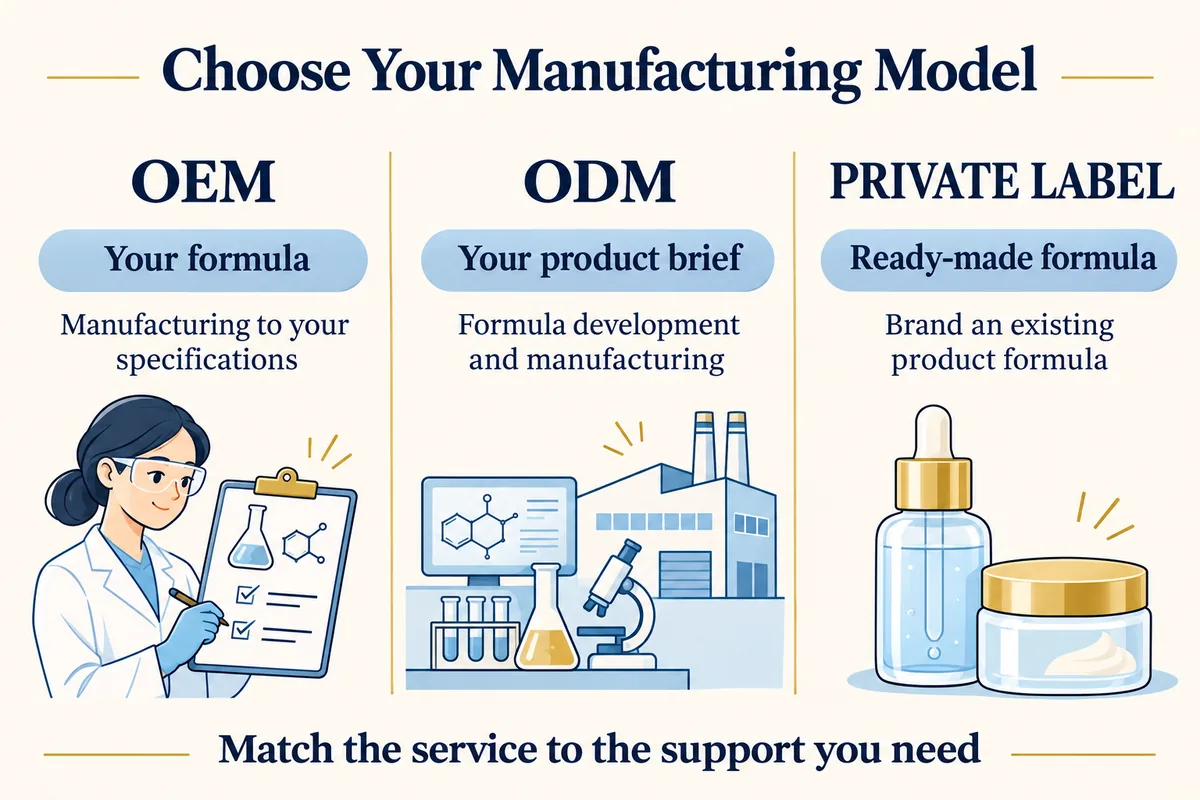
The table is comparative, not a set of industry standards: every factory sets its own MOQ and development schedule. Ask for both figures in writing, per SKU, with the packaging assumptions attached.
OBM, or original brand manufacturing, usually describes a factory developing and selling its own brand, although some suppliers use the term for broader brand-development services. A brand that already has its own research, marketing and sales channels and outsources only production is normally looking for cosmetics contract manufacturing, not OBM.
One question cuts through the terminology: ask the supplier to state in a single sentence who owns the formula IP and whether you could take it to another factory. If the answer is vague, a “custom” formula may be a stock base with a new fragrance. Clarify that before you pay a development fee. Private label, ODM and OEM are three distinct scopes of work, and we treat them as separate conversations for exactly this reason. You can see the categories we manufacture in our product range.
What Licenses and Certifications Should a Cosmetics Manufacturer Have?
At minimum, ask for a valid production licence covering your product category and the physical site that will make your order, plus a current quality-system certificate with its scope, issuing body and expiry date. Then check that the documentation matches the market where you plan to sell. A licence to manufacture in one country does not make a finished product compliant in another.
Six fields to check on every certificate
- Certificate or licence number, with a verifiable electronic copy.
- Issuing body, and a public register or contact you can verify it against.
- Issue and expiry dates — an expired certificate is a common, easily missed finding.
- Scope: which product categories and manufacturing processes it actually covers.
- Licensed production address, matched against the facility that will run your order.
- Legal entity name, matched against your contract, invoice and bank details.
When sourcing from a cosmetics manufacturer in China, verify the Cosmetics Production Licence against the issuing authority’s records; the National Medical Products Administration and provincial drug administrations are the reference point. Three failure patterns recur: the certificate covers a different address from the site doing the work, the scope excludes your product category, and the document expired between quotation and production. None of them shows up in a sales deck.
ISO 22716:2007 is the international guideline for the production, control, storage and shipment of cosmetic products; ISO’s own record shows it was last reviewed and confirmed in 2022. It is a guideline for a quality system, not a product approval and not a legal authorisation to sell. Certification such as ISO 22716 or GMPC supports your assessment, but it does not replace looking at how the system operates day to day. Apply the six checks above to the certificate itself rather than relying on a badge. Full certificate copies are commonly shared only under an NDA, which is a reasonable safeguard; what a buyer should still be able to see before that point is the certificate name, issuing body, scope and validity dates.
Match the paperwork to your target market
| Market | What the framework requires | What to ask your manufacturer for |
|---|---|---|
| United States | Under MoCRA: facility registration renewed every two years, product listing with ingredients updated annually, a named responsible person, safety substantiation and serious adverse event reporting. | Facility registration details, product listing support, safety substantiation records, and label and claims review against US rules. |
| EU / EEA | Regulation (EC) No 1223/2009: an EU-based Responsible Person, a Product Information File, a Cosmetic Product Safety Report and CPNP notification. See the European Commission cosmetics sector page. | Full INCI and raw-material data, PIF and CPSR inputs, formulation and safety data, and written confirmation of who handles notification. |
| China | A valid Cosmetics Production Licence, plus product filing or registration depending on the product category. | Licence with a matching production address, and confirmation of who prepares the filing or registration dossier. |
“FDA registered” is used loosely in supplier marketing. Registration under MoCRA applies to the facility; listing applies to products. Neither is an approval of the cosmetic itself. Ask what the registration actually covers and request the number, then verify it. The same discipline applies to ISO claims: ask for the certificate, not the logo.
How Should You Evaluate Samples and Audit the Factory?
Judge a sample on three things at once: how the formula behaves over time, what documents come with it, and whether the supplier hits the dates it promised. A pleasant texture on day one tells you very little on its own.
1. Stability and compatibility
Ask which tests will be run at each stage — accelerated and real-time stability (commonly 4, 8 and 12-week checkpoints), packaging compatibility, microbiological challenge testing, and heavy-metal and microbial limits — and which of those reports you will actually receive. Clarify whether reports are batch-specific or formula-level: a report for a stock base is not a report for your finished product in your chosen pack.
One recurring issue with botanical formulas is colour drift and precipitation when plant extracts meet certain preservative systems or high-electrolyte actives. We screen for this early with compatibility trials in the intended packaging, because a sample that looks perfect in week one can separate by week eight. Ask a prospective supplier how they would detect and resolve that specific risk. The answer is often more revealing than the sample.
2. The document pack
| Document | What it tells you | When to expect it |
|---|---|---|
| Full INCI ingredient list | What is in the formula, for label and regulatory review | Sample stage |
| Certificate of Analysis (COA) | Batch-specific measured results against specification | Bulk order, each batch |
| SDS / MSDS | Safe handling, transport and storage information | Sample stage / shipment |
| Stability report | Behaviour of the formula over time and under stress | Before bulk approval |
| Packaging compatibility report | Whether the formula and container interact | Before bulk approval |
| Microbiological challenge test | Preservative efficacy in the finished formula | Before bulk approval |
| PIF / CPSR inputs, free sale or export certificates | Market-specific regulatory support | On request, for the destination market |
3. Lead times, records and the site visit
Record the date you approve the formula and packaging, and the date the sample ships. Our published service levels are a 24-hour quotation, 48-hour samples and 15-day bulk production; your supplier should be able to give you equivalent numbers and, crucially, say when the clock starts. A quote that cannot define the start date is not a schedule.
If you can visit the site, look past the showroom: cleanliness of production areas, material labelling and status tags, segregation of raw materials and finished goods, weighing and calibration records, line clearance between batches, retained samples and the QC lab’s own test records. Ask what happened the last time a batch failed release and how it was resolved. Day-to-day records tell you more about management standards than a guided tour does.
What Should Be in Your MOQ and Pricing Agreement?
Get MOQ, the full cost breakdown, the production schedule and the quality remedies in writing before you pay a deposit. MOQ is usually set per SKU rather than per order, and it moves with packaging choices — a custom mould, a speciality pump or a printed carton can raise it substantially.
| Cost line | Often quoted separately? | What to confirm |
|---|---|---|
| Formula development / sampling fee | Frequently | Is it refundable or credited against a bulk order? |
| Primary packaging, moulds and tooling | Frequently | Who owns the tooling, and what is the minimum run? |
| Printing plates and setup | Frequently | Minimum print quantities and artwork revision charges |
| Testing and regulatory documents | Varies | Which reports are included, and are they batch-specific? |
| Filling, assembly and in-process QC | Usually in the unit price | What is and is not in the quoted unit price |
| Process loss and overage tolerance | Usually in the unit price | Accepted tolerance on delivered quantity |
| Freight, insurance, duties and taxes | Usually separate | Incoterms and who is responsible for customs clearance |
Also agree when delivery starts (normally approval of the formula and packaging, not the date of the deposit), what approvals are required along the way, how delays are handled, and how defects will be assessed and remedied if goods do not meet the agreed specification. These clauses are unglamorous, but they are the ones that matter when something goes wrong.
For a first launch, keep the first run small enough to test the whole chain — sample approval, production, documentation, shipping and customer feedback — rather than tying up your budget in inventory. Our published MOQ starts at 1,000 units per SKU from a library of 2,000+ stock formulas, but MOQ varies by formula complexity and packaging and is confirmed during quotation. Treat any number a supplier gives you the same way: ask for the conditions attached to it. Ask us for an itemised quotation to see the full cost structure before you compare unit prices.
Why Does Category Experience Matter When Choosing a Skincare Manufacturer?
Because formulation problems are category-specific. A factory experienced in anhydrous balms will not automatically handle a high-water-content botanical serum, an emulsion with unstable actives, or a sheet mask essence with a tight preservative challenge. Ask for examples in your category, then test the formulation and process controls behind them, subject to client confidentiality.
At BenjenLabs (Guangzhou Benjen Biotechnology Co., Ltd.), botanical skincare is our core manufacturing category. We publish a library of 2,000+ stock formulas, MOQs from 1,000 units per SKU, 48-hour samples and 15-day bulk production, and we state ISO and GMPC certification on our site. We would rather you check those claims than take them on trust: read our company and quality information, browse the categories we manufacture, then use our enquiry form to request samples, an itemised quotation and the certificate details you need for your initial review. Ask us how we handle documentation requests during supplier qualification — then run the same tests described in this guide before committing to an order.
A useful interview question for any supplier: describe a formulation in our category that did not work first time, and what you changed. A factory that can talk through a failed stability trial and the fix usually has real bench experience. One that says nothing ever goes wrong usually does not. Put category evidence in your supplier checklist instead of comparing unit price alone; what a manufacturer does well has a direct bearing on what it can deliver for your brand.
A 4-Step Checklist for Vetting a Cosmetics Manufacturer
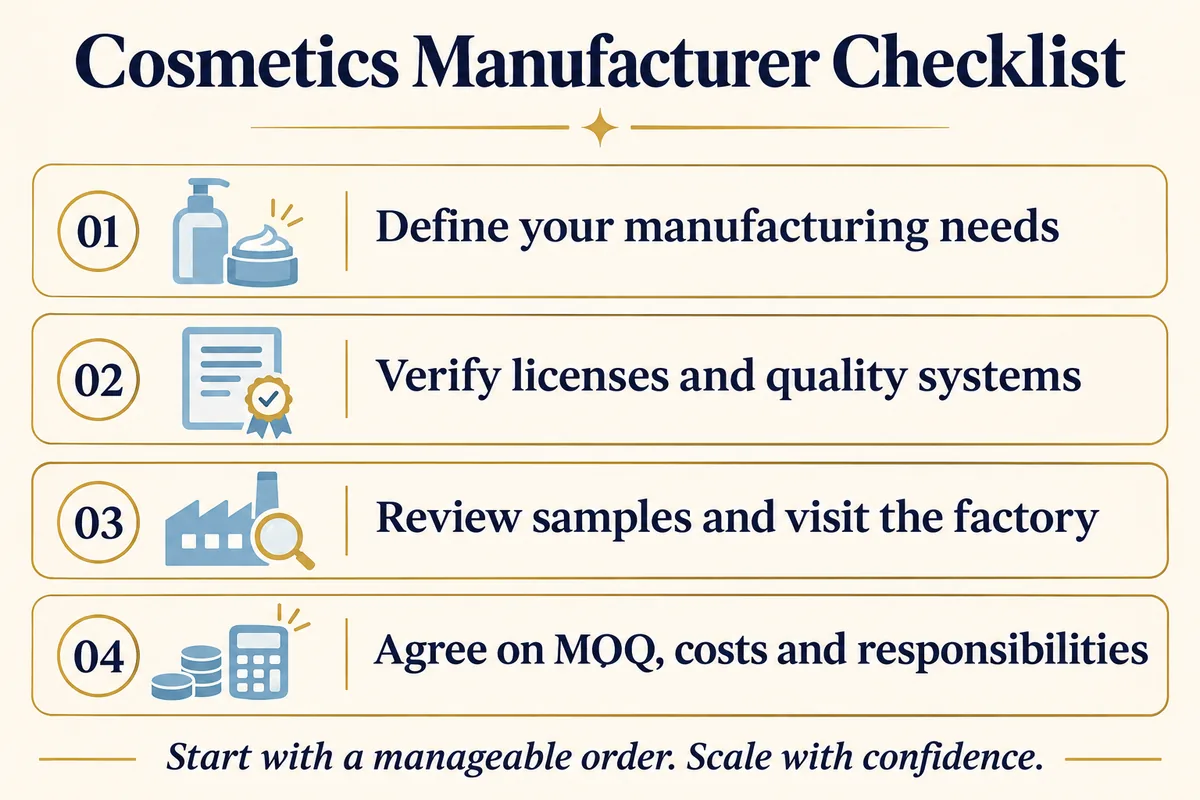
- Define the scope. Decide whether you need an existing private label formula, custom development or production to your own specification. Confirm who owns the formula IP, what customisation is included and which tests it triggers.
- Verify credentials. Check the production licence, the validity, scope, issuing body and address of quality-system certificates, and that the legal entity matches your contract. Match the documentation to your target market.
- Evaluate samples and operations. Review stability and compatibility data, the full document pack and sample lead times. Visit the factory if you can and ask to see batch records and the QC lab.
- Put commercial terms in writing. Agree MOQ per SKU, itemised costs, delivery triggers, delay handling and defect remedies. Start with a production quantity you can realistically manage, then scale on evidence.
Copy these four steps into the RFQ template you send to every supplier. Scoring each candidate against the same questions is what turns a shortlist into a decision — and it makes the differences between quotations visible.
Frequently Asked Questions
What is the difference between OEM, ODM and private label cosmetics?
OEM means you supply the formula and specification and the factory produces to it. ODM means the factory develops the formula from your brief. Private label means you select an existing stock formula and sell it under your own brand. The models differ in who owns the formula, how much testing is needed, and how long development takes. Because suppliers use the terms loosely, always confirm the actual scope of work in writing rather than relying on the acronym.
What certificates should a cosmetics manufacturer have?
Ask for a valid production licence covering your product category and the site that will make the order, plus a current quality-system certificate such as ISO 22716 or GMPC. Check the certificate number, issuing body, expiry date, scope and licensed address, and verify the legal entity name matches your contract. ISO 22716 provides guidelines for a quality system; it is not a product approval or a licence to sell in any market.
What is a typical MOQ for private label skincare?
MOQ is normally set per SKU rather than per order and changes with formula complexity and packaging. Stock private label formulas sit at the lower end, while custom development and bespoke packaging sit at the higher end. Ask for the figure in writing, together with the packaging assumptions, any tooling or print minimums, and whether a smaller first run is possible. A single number without conditions is not a useful answer.
How long does sampling and bulk production take?
Ask for two numbers, and for the event that starts each clock: the interval from formula and packaging approval to sample dispatch, and from sample approval to bulk dispatch. Record the approval dates yourself and compare them with the actual ship dates. A supplier that cannot say when the clock starts is a schedule risk, regardless of how short the quoted interval is, because that is where most disputes about delays begin.
Does a cosmetics manufacturer need FDA approval to export to the US?
FDA does not approve cosmetic products before sale, apart from colour additives. Under MoCRA, facilities manufacturing or processing cosmetics for the US market must register with FDA and renew every two years, and a responsible person must list each marketed product and its ingredients and update the listing annually. Ask your supplier for the facility registration details and confirm what product listing and safety substantiation support they provide.
What documents should I receive before placing a bulk order?
At minimum: a full INCI list, a sample or batch Certificate of Analysis, an SDS, stability and packaging compatibility data, microbiological challenge test results, and the test reports themselves. Confirm whether each report is batch-specific or formula-level, and which regulatory documents your target market requires. If a supplier can describe the tests but cannot produce the reports, treat that as a gap in the quality system.
Can my manufacturer handle EU CPNP notification?
Notification is the responsibility of the EU-based Responsible Person, not the factory. A manufacturer can support it by supplying formulation data, raw-material information, Product Information File inputs and Cosmetic Product Safety Report data. Confirm in writing which documents they provide, who acts as Responsible Person, and who maintains the PIF. Regulation (EC) No 1223/2009 sets the framework, and requirements should be checked against current guidance before launch.
Final thought
Choosing a cosmetics contract manufacturer is a due-diligence exercise, not a beauty contest. Start with a clear understanding of what you need, what you can manage and what you can afford; ask for evidence rather than assurances; prove the process with a manageable first order; then use the results to guide the next stage of growth. The six checks above will not identify a perfect supplier overnight, but they will help you rule out unsuitable ones before you sign a contract.
About the author
Sources and further reading
- International Organization for Standardization, ISO 22716:2007 — Cosmetics, Good Manufacturing Practices, Guidelines (last reviewed and confirmed 2022).
- U.S. Food and Drug Administration, Modernization of Cosmetics Regulation Act of 2022 (MoCRA).
- European Parliament and Council, Regulation (EC) No 1223/2009 on cosmetic products.
- European Commission, Cosmetics — Internal Market, Industry, Entrepreneurship and SMEs.
- National Medical Products Administration (NMPA), China — cosmetics production licensing and product filing.
Regulatory requirements change. Confirm current obligations with the relevant authority or a qualified regulatory consultant in your target market before launch. Links checked 11 November 2026. This article provides general sourcing guidance and is not legal or regulatory advice.